To Flash, or Not to Flash
Before I start, I'd like to point this out--this post is going to be written based on my personal experience. I am not very good at explaining technical stuff, especially with things I'm not too familiar with yet. Also, I would hate to pretend I know what I am talking about--because, quite frankly, I am not too sure, either. I will refer you to a few sites that I found that have been helpful to me. I enjoy learning, and I have said this before--the learning process is endless. I don't think I will ever stop learning.
Anyhow. Ever since I became addicted to, I mean, fell in love with photography, I have been attracted to the beauty of utilizing natural light. I have taken more than 10,000 pictures, but only less than twenty that my built-in flash has actually popped out and helped. Some of those were accidents, but some weren't. I like to experiment with different shutter speeds and apertures. I also like to keep my ISO at the highest 400. As a result, I purchased a few faster lenses (50mm f 1.8, and 85mm f 1.8), and the photos that came out from those two particular lenses were beyond satisfying. With those two lenses, I was able to keep my ISO at 200 most of the time. Sometimes, in darker situations, I will raise it to 400. No big deal.
The challenge came when I was practicing shooting at a wedding a few weeks ago. I refused to use my built-in flash, and I didn't know much about external flash units, so I brought my camera to the wedding, thinking I would do okay.
The shots came out beautiful--that is, until nightfall, when we moved to the reception site. Like most weddings, the reception was held indoor, with different types of artificial lighting. I tried to keep my ISO at 400, to no avail. Then I adjusted to 800, when my skin began to crawl. Still horrible. Finally, I screamed (in my head), and cranked it up to 1600 (I have a Rebel Xti, which only allows you to adjust your ISO in those increments). Here's a shot with that result: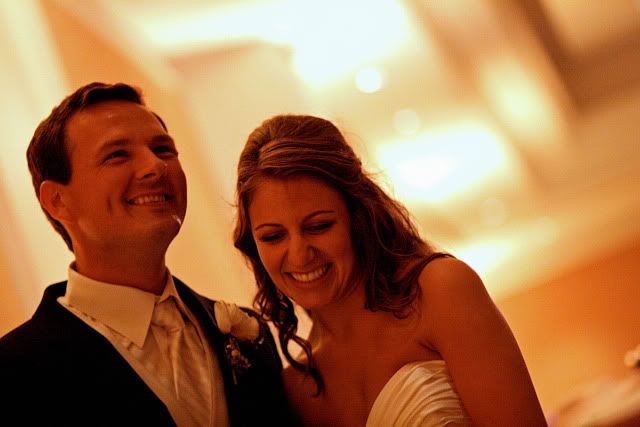
Not too horrible, you would think I added the "noise" on purpose...right?
Well, I hated it. I had no choice. The only good thing was that both the bride and the groom looked pretty sharp. That was the moment I began to ponder, whether or not I should make a commitment to purchasing a flash.
And so I began doing my research. I asked my next-door neighbor, whose photography work is amazing (here is his website). Long story short, he introduced me to the Speedlite 580 EX (not to be confused with the Speedlite 580 EXii).
Fancy name, I know. And I'd be lying if I were to tell you that I knew exactly what Speedlite 580 EX was. Not only did he allow me to come and bother him and his lovely, pregnant wife (on a Friday night), he took the time and explained how to use this thing in the simplest form of English. On top of everything else, I got to play with it.
Holding this what I considered a "high-tech" gear, I went straight to my computer. I googled away, and found this article, which basically was an "external flash 101". Looking at the many buttons and functions, I became discouraged right away. How in the world would I possibly become familiar with every single function, and every combination of different settings??
So I tried. I fired away, flashed away. I only played around with a few settings, and I fell in love with it. With this unit, all I know is I can keep a low enough ISO and still achieve a natural look. I'll show you what I mean (the picture with my sister at the dinner table--the left side was shot using a built-in; the right, external):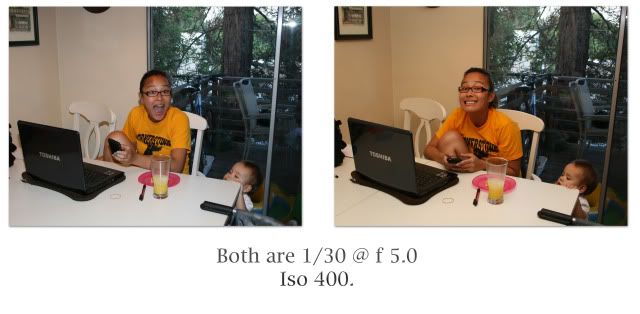
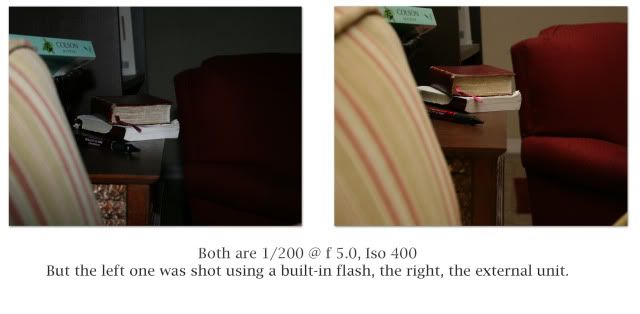
At the end of the day, I can safely say that I have changed my perspective on using a flash. No, I still won't use my built-in flash. But an external flash unit?? In my opinion, it's worth the investment.
If you want to further your knowledge on how external flash units work at a deeper lever, my neighbor wrote this article.